
The short version
- The Taxpayer Assistance and Service (TAS) Act passed the Senate by unanimous consent on September 30, 2026. It is now before the House, which returned on November 9. It is not law yet.
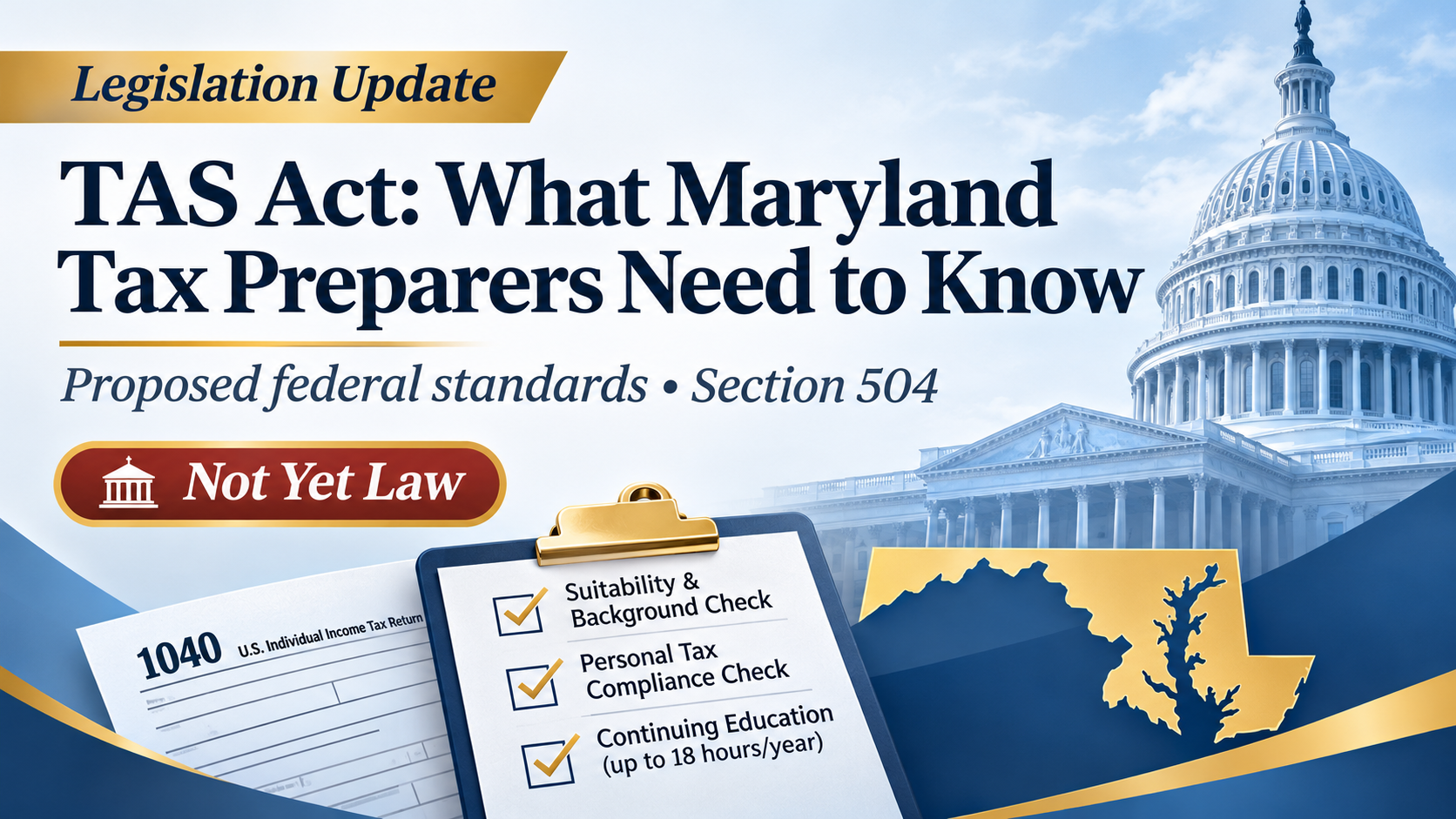
- Section 504 would, for the first time, set minimum federal standards for paid preparers who are not CPAs, enrolled agents or attorneys: a suitability and background check, a personal tax compliance check, and up to 18 hours of continuing education a year.
- CPAs, enrolled agents and attorneys in good standing are exempt.
- Maryland-registered preparers have a strong path to meet the requirement through their state registration, but it is not automatic. Treasury would have to decide that Maryland’s program is “comparable.” Maryland already requires an exam and a background check, so continuing education hours are the most likely sticking point.
Where the bill stands
- February 26, 2026: Senators Crapo (R-ID) and Wyden (D-OR) introduce S. 3931.
- July 30, 2026: Senate Finance Committee approves a modified version, 26-1.
- September 30, 2026: Full Senate passes it by unanimous consent. The TAS Act text was substituted into a House bill that had already passed, the Tax Court Improvement Act (H.R. 5349).
- Now: The House can take it up in the post-election session. If it passes the House unchanged, it goes to the President. If the House changes it, the Senate must act again.
The bill has 65 provisions across about a dozen titles. Most deal with IRS customer service, taxpayer rights, the Tax Court and the Independent Office of Appeals. The preparer provisions are in Title V.
What the bill does overall
- IRS service: electronic processing of paper returns, a public dashboard of wait times and backlogs, better refund tracking, expanded online accounts, and a goal of callbacks after five-minute phone waits by 2028.
- Low-income taxpayers: protects certain EITC refunds from offsets, removes installment agreement fees for low-income taxpayers and expands Low-Income Taxpayer Clinic funding.
- Tax Court and Appeals: raises the small tax case limit from $50,000 to $100,000, expands refund jurisdiction to $2 million, and requires Appeals to act on refund claims within 12 months.
- Taxpayer Advocate Service: gives the National Taxpayer Advocate its own hiring authority.
- Small businesses: allows voluntary withholding for independent contractors and moves the farmer and fisher estimated tax deadline to April 15.
- Fraud and data security: moves some information return deadlines from March 31 to January 31 and raises penalties for unauthorized disclosure.
- E-file security: creates an automated system to confirm that an EFIN is active and authorized.
Section 504: what non-credentialed preparers would face
Today, anyone who pays the PTIN fee gets a PTIN. Since the 2014 Loving v. IRS decision, the IRS has had no authority to set competency standards for non-credentialed preparers. Section 504 would give the IRS that authority by law.
To get or renew a PTIN, a non-credentialed preparer would have to meet one of these paths:
- The federal path: suitability plus continuing education (described below).
- The state path: hold a valid state license or registration from a program Treasury deems comparable (see the Maryland section).
- Specified practitioner: CPAs, attorneys and enrolled agents in good standing. These are exempt.
Suitability
- Provide information the IRS requires and pass a background check.
- The check includes a review of the preparer’s own personal tax compliance.
- A preparer fails suitability if a state license or registration has been suspended or revoked.
- The IRS may grandfather groups who already passed a background check, but not the personal tax compliance review.
Continuing education
- Courses must cover ethics, professional responsibility and tax law, including recently enacted federal tax legislation.
- No more than 18 hours a year may be required. 18 is the ceiling, not a set requirement. The IRS would decide the actual number in regulations.
- Each course must include a way to confirm attendance and that the preparer “sufficiently understood the material presented.” This is a course-level knowledge check, similar to quizzes in current CE.
- The IRS may require extra courses for a specific preparer based on errors found on returns filed under their PTIN.
- The IRS may not require preparers to use a particular provider. It will publish a list of approved programs.
- A preparer who misses the requirement gets notice and 30 days to cure.
What Section 504 does not do
- No entrance exam. The bill bars the IRS from requiring an exam to get or renew a PTIN, other than the course-level comprehension checks.
- No licensing board. Supporters, including the National Taxpayers Union and NATP, stress that the bill creates no initiation fee or licensing board.
Enforcement
After notice and a chance for a hearing, the IRS could suspend or revoke a PTIN for:
- failing the suitability, education or state program requirements;
- incompetence, shown by a repeated pattern of errors that affect tax liability;
- disreputable conduct, such as giving false information, willfully not meeting personal tax obligations, a tax debt unpaid more than 180 days (with exceptions), state license revocation, certain criminal convictions or injunctions;
- knowingly misleading or threatening taxpayers with intent to defraud.
The IRS could also impose a penalty of up to $5,000 per violation. In urgent cases it could suspend a PTIN for up to 180 days while a case is pending. Preparers could appeal. Suspensions longer than 180 days would be published on the IRS website.
Other preparer provisions in Title V
These apply to all paid preparers, credentialed or not.
- Altered returns (Sec. 501): Preparer penalties would apply to changes made after the taxpayer approves a return, including changes that divert a refund.
- Ghost preparers (Sec. 502): $250 for each failure to show a valid PTIN, up to $75,000 a year. Willful failure would be a felony.
- Higher penalties (Sec. 503): Most per-return penalties (not giving the client a copy, not signing, not keeping records) rise from $50 to $250, with higher annual caps. Due diligence penalties for EITC, CTC, AOTC and head of household rise from $500 to $1,000. Misappropriating a client’s refund would cost the greater of $1,000 or the full amount.
How this could affect non-credentialed preparers
- Time and cost. Preparers not already doing CE would have a new annual requirement. How heavy it is depends on the hours the IRS sets. Opponents assume the full 18 hours. Supporters expect far less; NTU predicts about 4 to 6 hours.
- Many preparers are already close. The IRS’s voluntary Annual Filing Season Program (AFSP) requires 18 hours (15 for exempt preparers). AFSP participants would likely be well positioned.
- Personal tax compliance matters. Unfiled returns or an unresolved tax debt could block a PTIN.
- Error patterns now have consequences. Repeated errors could lead to required extra courses or PTIN suspension.
- Higher penalties across the board, regardless of credential.
- Possible market effects. Opponents, led by the Institute for Justice, argue the requirements will push small, independent and seasonal preparers out of the business. Supporters, including NATP, the AICPA, NAEA and the National Taxpayer Advocate, argue they protect taxpayers with a modest burden.
Would this apply to Maryland-registered preparers?
Short answer: Maryland-registered preparers have a likely, but not guaranteed, path to meet Section 504 through their state registration.
What the bill says about state programs
- A preparer with a valid state license or registration meets the “state program” requirement if the state program includes examination, education and background check requirements comparable to the federal ones.
- Treasury decides comparability based on the state’s current rules, not the rules in place when the preparer first registered.
- If a preparer’s state registration is suspended or revoked, they fail federal suitability.
How Maryland’s program lines up
| Requirement | Federal (Sec. 504) | Maryland Board of Individual Tax Preparers |
|---|---|---|
| Exam | Comprehension checks within courses | State exam, 70% to pass (waiver paths exist for experienced preparers) |
| Continuing education | Up to 18 hours a year | 16 hours every 2-year renewal (about 8 a year) |
| Background check | Required, plus personal tax compliance review | Required |
| Exempt | CPAs, EAs, attorneys | CPAs, EAs, attorneys, certain government employees |
What that means
- Exam: likely a strength. Maryland is one of only three states (with California and Oregon) whose program the IRS already recognizes for the AFSP exempt track, because registrants passed a state competency test. That is a good sign Treasury would view the program favorably.
- Education: possible gap. Maryland’s 16 hours every two years is less than the federal ceiling. Whether it’s “comparable” depends on how many hours the IRS sets.
- Background check: met. Maryland requires one, which covers a key federal element. One open question: the federal check also reviews the preparer’s personal tax compliance, so Treasury may look at whether Maryland’s check covers that too.
- If Maryland isn’t deemed comparable, Maryland-registered preparers would need to meet both systems: the federal suitability and CE requirements for their PTIN, and Maryland’s requirements for state registration. CE that counts toward both would help.
- CPAs and EAs are exempt under both systems, so they’re unaffected either way.
Possible next steps for MSATP
- Document the details of Maryland’s background check, including whether it covers personal tax compliance, so we’re ready to show Treasury the program is comparable.
- After enactment, push early for a Treasury comparability determination for Maryland.
- Through the Comptroller’s Tax Practitioner Advisory Council, raise state and federal alignment so Maryland preparers aren’t stuck with two sets of requirements.
- Prepare members: urge non-credentialed members to keep their personal tax filings current and consider AFSP now.
- Position MSATP CE to satisfy both Maryland renewal and any federal requirement.
Caveats and what to watch
- Bill text may differ. The Section 504 details above come from the bill as introduced (S. 3931). The Finance Committee modified the bill before Senate passage, and the House could change it further. Check the final enacted text before advising members.
- The IRS writes the details. The actual CE hours, course standards, background check process and timeline would come from IRS regulations after enactment.
- No effective date confirmed. We did not find a general effective date for Section 504. Requirements would likely be phased in after regulations are issued.
- Watch the House. The House has passed many tax administration bills one at a time and may not take up the Senate package as-is.
Sources
- NAEA, Summary of the Taxpayer Assistance and Service (TAS) Act: https://www.naea.org/summary-of-the-taxpayer-assistance-and-service-tas-act/
- S. 3931 bill text (as introduced), GovInfo: https://www.govinfo.gov/content/pkg/BILLS-119s3931is/html/BILLS-119s3931is.htm
- Thomson Reuters, Senate passes broad tax administration reform legislation: https://tax.thomsonreuters.com/news/senate-passes-broad-tax-administration-reform-legislation/
- KPMG, Senate passes tax administration reform package (Oct. 1, 2026): https://kpmg.com/us/en/taxnewsflash/news/2026/10/senate-passes-tax-administration-reform-package.html
- Fox Rothschild, TAS Act Title V: Tax Return Preparers: https://taxcontroversy.foxrothschild.com/2026/04/taxpayer-assistance-and-service-act-title-v-tax-return-preparers/
- NATP, response to opposition to Section 504: https://www.natptax.com/news-insights/press-center/natp-responds-to-opposition-to-section-504-of-taxpayer-assistance-and-service-act/
- National Taxpayers Union, Resetting the Record: https://www.ntu.org/publications/detail/resetting-the-record-irs-reform-helps-taxpayers-and-blocks-new-mandates
- Institute for Justice coalition letter opposing Section 504: https://ij.org/press-release/coalition-letter-opposition-to-federal-tax-preparer-occupational-licensing-and-section-504-of-the-draft-taxpayer-assistance-and-service-act/
- Maryland Department of Labor, Individual Tax Preparers registration and CE: https://labor.maryland.gov/License/taxprep/taxprepreq.shtml
- Maryland OneStop, Individual Tax Preparer Registration: https://onestop.md.gov/licenses/individual-tax-preparer-5d1540b654f24d03e999844e
- IRS, AFSP reduced requirements for exempt individuals: https://www.irs.gov/tax-professionals/reduced-requirements-for-exempt-individuals-for-the-annual-filing-season-program-record-of-completion