
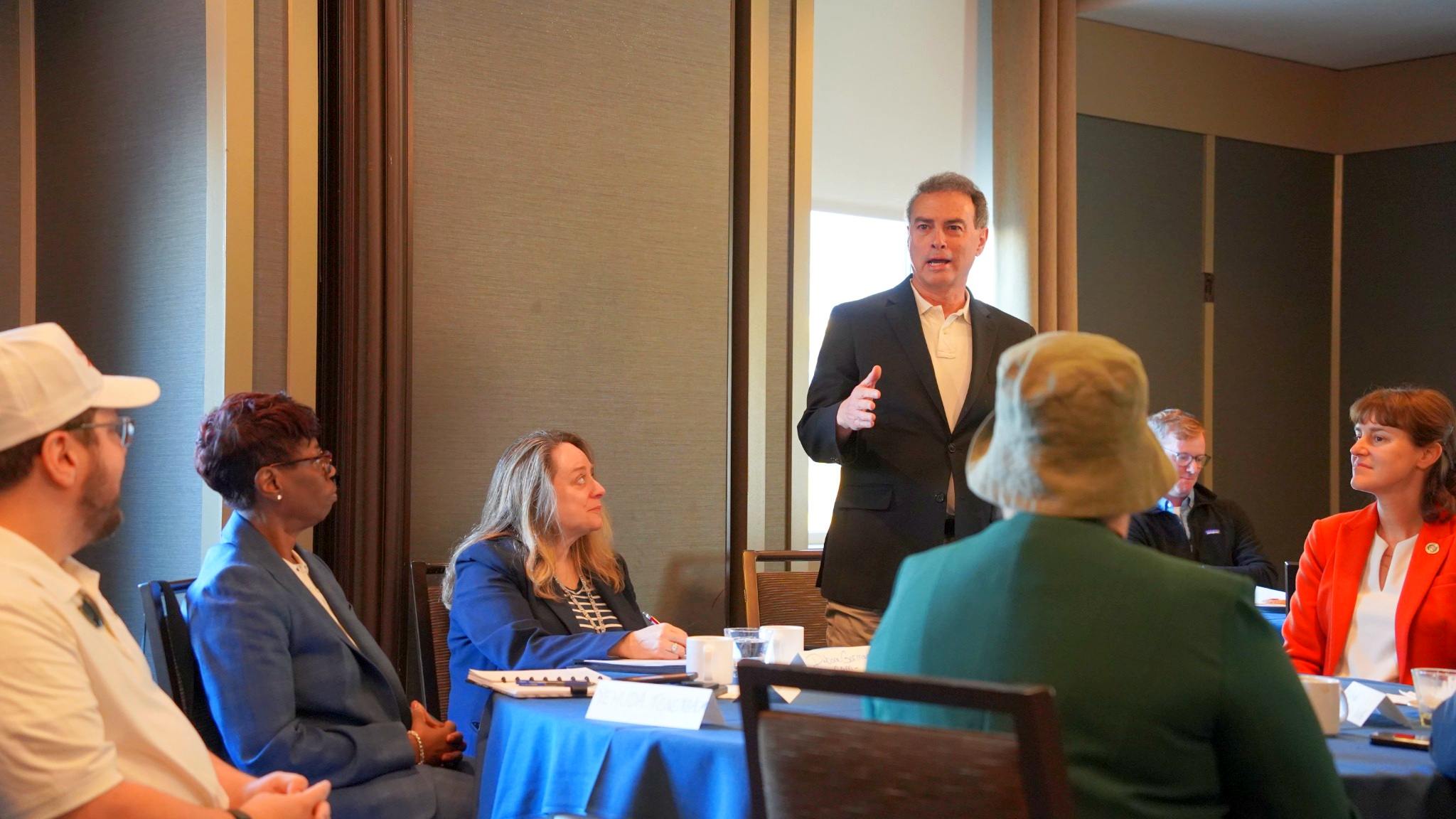
On the morning of Friday, October 23, 2026, in Annapolis, MSATP members spent two hours at a single table with six members of the Maryland General Assembly and senior leadership from the Comptroller’s Office. No slides, no podium, no panel — practitioners talking, lawmakers listening.
Who joined us
From the General Assembly: Delegate Jheanelle Wilkins, Chair of House Ways and Means; Delegate Jessica Feldmark, Vice Chair; Senator Brian Feldman; Delegate Kris Valderrama; Delegate Julie Palakovich Carr; and Delegate Caylin Young.
From the Comptroller of Maryland: Chief Deputy Comptroller Erica Roach, Legal Division Director Debora Gorman, and State Government Affairs Director Matthew Dudzic.
Making the Comptroller’s Office easier to work with
A substantial part of the morning went to practical, unglamorous problems:
- Improving the customer experience when a practitioner contacts the office
- Making submissions simpler on the preparer’s end
- Fixing the process when an incorrect notice goes out
- MSATP’s readiness to support the Comptroller’s budget request for additional staff
That last item deserves emphasis. Adequate staffing is the foundation for nearly every service improvement discussed on Friday, and MSATP is prepared to say so publicly when the budget is debated.
The backdrop: a budget gap, and the tax conversation that follows
Much of Friday’s discussion was shaped by a single fact — Maryland is facing a significant budget shortfall.
As of June, the Department of Legislative Services projected a structural gap of nearly $2.6 billion for fiscal 2028, while the Department of Budget and Management has been working from a figure closer to $3 billion. Projections for the two years after that run to roughly $3.4 billion each. Agencies have been asked to model reductions of about 3%, and two dozen Cabinet-level agencies were asked to outline cuts of up to 10%.
Cuts alone are unlikely to close a gap that size. House Appropriations Chair Ben Barnes has said “all options are on the table,” and the revenue options being discussed publicly are substantial — raising the sales tax from 6% to 7% would generate roughly $1.2 billion on its own.
For our members, that means new taxes and rate increases are very likely to be in question during the 2027 session. MSATP will be monitoring the budget and revenue debate closely and advocating for our members and their clients at every stage. The two conversations below are where that work begins.
Data centers and who pays their share
Members and legislators discussed how data centers should contribute to state and local revenue — particularly in places like Frederick County that have become an epicenter for development.
The mechanics matter. Frederick County has authority to levy a blanket business personal property tax but chooses not to, and the limited personal property it does tax doesn’t reach data centers. Taxing data center equipment therefore requires a change in state law — and the question is how to do it without pulling Frederick County’s small businesses into a tax they don’t pay today.
Last session’s answer was SB 427 and its cross-file HB 1595, which would have let counties and Baltimore City create a separate personal property subclass for qualified data centers and set a distinct rate for it. A subclass is exactly the tool that taxes data center equipment while leaving small business equipment alone. The bill was heard in Senate Budget and Taxation on February 18 and did not pass. Frederick County has estimated that a data center personal property tax at $1.80 to $2 per $100 of assessed value would generate roughly $67 million to $74 million annually.
Also worth knowing: under Chapter 640 of 2020, qualified data centers are already exempt from Maryland sales and use tax on qualifying personal property — the thresholds are $5 million in investment and five qualified positions within three years — and that same law lets local governments reduce or eliminate the assessment percentage on data center personal property. Ten data centers have been approved under the program so far.
Keeping professional services out of any tax expansion
Members made one point unmistakably clear: if new taxes or rate increases are on the table in 2027, professional services — tax preparation, accounting, bookkeeping — must stay out of them.
There is precedent to protect. The 2025 Budget Reconciliation and Financing Act imposed a 3% sales and use tax on data and information technology services effective July 1, 2025, reaching NAICS sectors 518, 519, 5132 and 5415. Accounting, tax preparation, bookkeeping and payroll services — NAICS 5412 — were not included.
That line held once. The argument for holding it again is simple: every Marylander has a legal obligation to comply with the tax laws, and the state should not tax the act of getting help to meet it.
What happens next
After the event, Delegate Palakovich Carr approached MSATP leadership to ask for a continuing conversation about expanding Maryland’s Offer in Compromise program as she prepares for the 2027 session.
That is what a successful roundtable produces. Not a thank-you note — a legislator asking for practitioner expertise while there is still time to shape a bill.
From now through the close of the 2027 session, MSATP will be tracking tax legislation as it is introduced and moves through committee, and we will be ready to support or oppose it on your behalf. Where a bill would make compliance simpler or fairer for Maryland taxpayers and the practitioners who serve them, we will say so — in writing, in person, and in the conversations that happen before a bill is ever drafted. Where a bill would add cost, complexity, or administrative burden without a corresponding benefit, we will say that just as plainly.
We will keep members posted as bills move, so you always know where your association stands and can add your own voice when it matters most.
Help us keep the seat at the table
Friday happened because MSATP has spent years building these relationships. The MSATP PAC is part of how we sustain them and keep practitioners in the room when Maryland tax policy gets written. If the morning mattered to you, a contribution of any size is the most direct way to say so.
Thank you to everyone who gave up a Friday morning in October.